

Most couples don’t come into therapy saying, “We’re experiencing the Four Horsemen of the Apocalypse.”
They come in saying things like:
“We keep having the same fight.”
“I don’t feel heard.”
“One of us shuts down.”
“It feels like we’re on opposite sides.”
“I’m exhausted.”
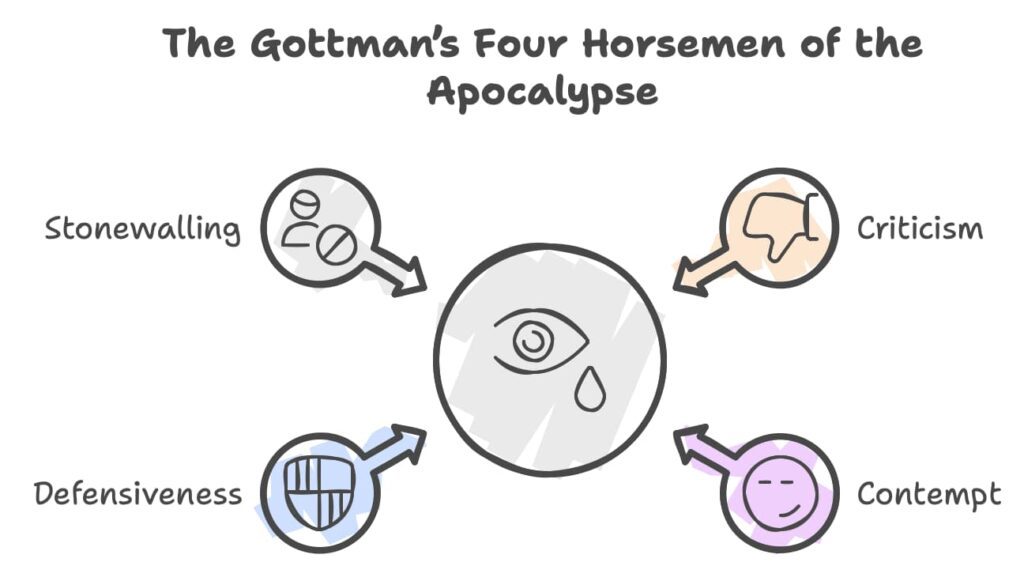
When we slow those statements down, what often shows up underneath are the same four patterns John Gottman identified decades ago: criticism, defensiveness, stonewalling, and contempt.
The names sound dramatic. They can feel ominous.
But in practice, I don’t experience the Four Horsemen as signs that a relationship is doomed. I experience them as signs that nervous systems are under pressure.
These Aren’t Personality Flaws. They’re Protection.
One of the most important things to understand about the Four Horsemen is this:
They are not character traits.
They are not evidence that someone is “toxic.”
They are not proof that love has disappeared.
They are protective patterns.
Each one makes sense when you listen for what the nervous system is trying to do.
- Criticism is often a protest—an attempt to be seen or to matter.
- Defensiveness is protection against shame.
- Stonewalling is overwhelm, not indifference.
- Contempt is pain that has been carried for too long without repair.
When couples get stuck in these patterns, it’s rarely because they don’t care.
It’s because their bodies are reacting faster than their insight.
Why the Horsemen Travel in Packs
The Four Horsemen almost never show up alone.
They form cycles.
One partner reaches for connection, but fear sharpens their words into criticism.
The other feels attacked and becomes defensive.
The nervous systems escalate until someone shuts down.
Unrepaired hurt quietly accumulates and resentment hardens.
Eventually, contempt can enter the room.
This isn’t sabotage. It’s pattern memory.
The body remembers what hasn’t been resolved yet.
An Attachment Lens: Longing Beneath the Pattern.
Through an attachment lens, the Horsemen stop looking cruel and start sounding… desperate.
Criticism often says, “Please notice me.”
Defensiveness says, “Please don’t make me the bad one.”
Stonewalling says, “Please stop, I can’t manage this.”
Contempt says, “Please don’t hurt me again.”
When we only respond to the surface behavior, we miss the longing underneath.
And missed longing is where cycles get reinforced.
Where Trauma Lives in These Patterns
This is where trauma-informed work—and EMDR in particular—becomes so relevant.
From an Adaptive Information Processing perspective, many of these reactions are not about the present argument at all. They’re driven by older memory networks where:
- Needs weren’t consistently met
- Conflict felt unsafe
- Repair didn’t happen
- Emotions were too much—or not allowed at all
When current relationship stress activates those networks, the body responds before reason can step in.
That’s why people often say, “I don’t know why I reacted that strongly,” or “It felt bigger than what just happened.”
Because it was.
How EMDR Can Help Shift These Patterns
EMDR doesn’t teach couples how to communicate better first.
It helps the nervous system stop reacting like the past is still happening.
When underlying memory networks are reprocessed, something important changes:
- Criticism softens into clearer expression of need
- Defensiveness loosens as shame loses its grip
- Stonewalling decreases as tolerance for activation increases
- Contempt often reveals the grief and exhaustion underneath
Not because someone “learned a skill,” but because their system no longer has to protect in the same way.
This is where couples often experience relief—not by trying harder, but by becoming less hijacked.
The Myth of “Good Couples.”
There’s a myth that healthy couples don’t use the Four Horsemen.
They do.
What predicts relationship health isn’t their absence, but their frequency, rigidity, and repair.
Healing relationships aren’t conflict-free.
They’re repair-rich.
When EMDR and relational work come together, repair becomes more accessible because reactions don’t escalate as high—or last as long.
What Healing Looks Like Over Time…
As these patterns heal, couples often notice:
- Less intensity in conflict
- Shorter shutdowns
- More curiosity
- Greater emotional safety
- Faster repair
Not perfection.
Just more room to come back to each other.
A Final Thought
The Four Horsemen are not a verdict on your relationship.
They are information.
They tell us where the nervous system is overwhelmed, where old wounds are active, and where connection is still trying to happen—sometimes clumsily, sometimes painfully, but persistently.
When we stop moralizing these patterns and start understanding them, healing becomes possible.
Not because couples stop struggling, but because they learn how to return—to themselves and to each other.