

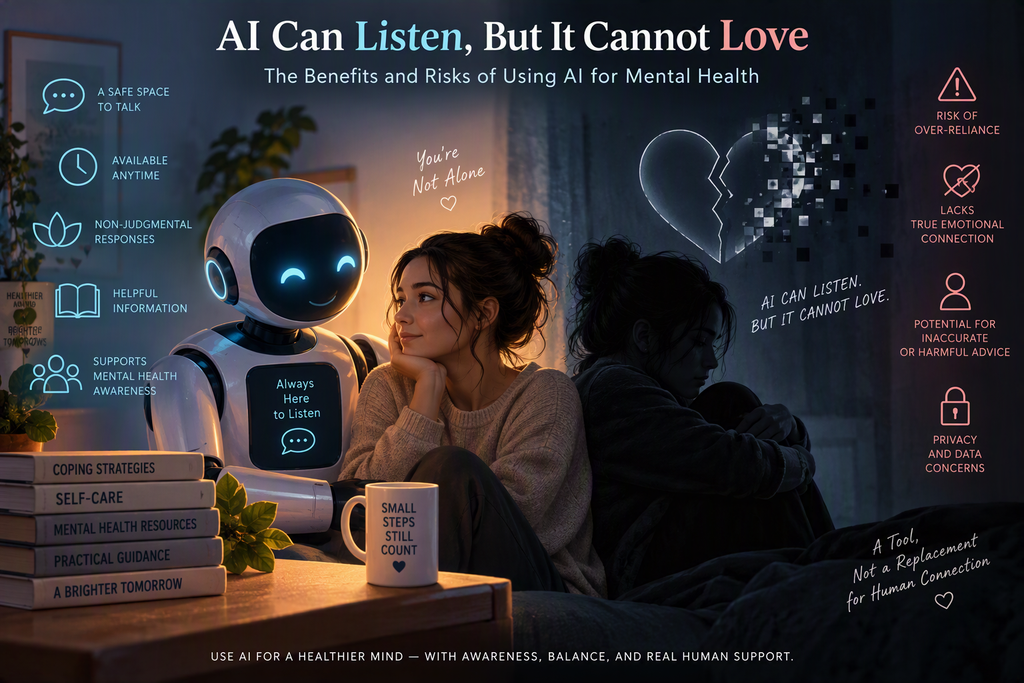
Can AI help with mental health?
It’s a question I’m hearing more often from clients, colleagues, and even friends. As artificial intelligence becomes increasingly woven into our daily lives, many people are turning to AI tools for emotional support, mental health advice, relationship guidance, and even trauma recovery.
And honestly, I understand why.
AI is available 24 hours a day.
There’s no waitlist.
It’s free or low-cost.
It responds immediately.
For someone struggling with anxiety, loneliness, overwhelm, or emotional pain, it can feel like a lifeline.
As a therapist, I don’t think artificial intelligence is something we should fear. Like most tools, AI has tremendous potential when used wisely. But I also think we need to have an honest conversation about what AI can do, what it cannot do, and the risks that many people aren’t considering when they turn to AI for mental health support.
Because while AI may be able to provide information, healing is about much more than information.
The Benefits of AI for Mental Health
Let’s start with the positives.
There are absolutely ways AI can support emotional wellness and mental health growth.
Many people are using AI to:
- Organize overwhelming thoughts
- Create journaling prompts
- Learn about anxiety, trauma, or relationships
- Develop mindfulness practices
- Explore coping strategies
- Identify patterns in their thinking
- Prepare topics for therapy sessions
- Practice difficult conversations
- Build routines that support emotional wellness
In many ways, AI can function as an intelligent reflection tool.
For people who struggle to put thoughts into words, AI can help create clarity. It can help someone slow down, reflect, and gain perspective on what’s happening internally.
I often compare it to having an incredibly sophisticated notebook. It can help you sort through ideas, identify themes, and become more intentional about your growth.
Those are meaningful benefits.
The problem begins when people start expecting AI to do something it was never designed to do.
When AI Becomes a Substitute for Human Connection
One of the biggest concerns I have about AI and mental health isn’t necessarily inaccurate information.
The larger concern is that AI can create the feeling of connection without actually providing connection.
As human beings, we are fundamentally relational creatures.
Our nervous systems develop in relationships.
Our attachment styles develop in relationships.
Our sense of safety develops in relationships.
And many of our deepest emotional wounds happen in relationships.
Trauma is often more than a painful event. It is the experience of facing pain without sufficient support, protection, attunement, or connection.
Because of this, healing is not simply about understanding your experiences intellectually.
Healing involves experiencing something different.
That “something different” almost always happens in relationship.
Why the Therapeutic Relationship Matters
One of the topics that emerged repeatedly during conversations at EMDRIA was the importance of the therapeutic relationship itself.
In trauma therapy, we often talk about the therapeutic relationship as the container.
The relationship provides safety.
The relationship provides regulation.
The relationship creates opportunities for trust, repair, vulnerability, and connection.
A therapist is not simply offering information.
A therapist is offering presence.
That distinction matters.
AI can help you think through an experience.
A therapist can sit with you in that experience.
AI can generate empathetic language.
A therapist can offer genuine empathy.
AI can mirror your words.
A therapist can notice your body language, tone of voice, emotional shifts, patterns of avoidance, and relational dynamics.
Those differences are not small.
Those differences are the work.
AI Is Designed to Respond. Therapy Is Designed to Heal.
Another issue people don’t often consider is that most AI systems are designed to be engaging and responsive.
They are designed to continue the conversation.
Therapy is different.
Therapy isn’t about keeping you comfortable at all costs.
Sometimes healing requires challenge.
Sometimes growth requires discomfort.
Sometimes a therapist notices contradictions, blind spots, avoidance patterns, or behaviors that are keeping someone stuck.
A skilled therapist doesn’t simply validate everything a person says.
A skilled therapist helps people move toward deeper understanding, accountability, integration, and healing.
That’s a level of clinical judgment that artificial intelligence simply cannot replicate.
The Risk of Emotional Dependency
Another danger that deserves more attention is emotional dependency.
Because AI is always available and often highly validating, it can become easy to develop an attachment to it.
For people struggling with loneliness, attachment wounds, social anxiety, depression, or isolation, an AI companion can begin to feel safer than actual relationships.
Unfortunately, that sense of safety can become misleading.
Healthy relationships require mutuality.
They require vulnerability.
They require navigating misunderstandings, boundaries, repair, and real human complexity.
AI asks very little of us.
Human relationships ask much more.
And while that can feel uncomfortable, it is often the very thing that facilitates growth.
The goal is not to eliminate our need for people.
The goal is to strengthen our capacity for connection.
The Privacy Concerns Most People Overlook
Another issue that rarely gets discussed enough is privacy.
Many individuals are sharing deeply personal information with AI systems, including:
- Trauma histories
- Relationship struggles
- Family conflicts
- Medical information
- Mental health concerns
- Personal vulnerabilities
What many people don’t realize is that using an AI chatbot is not the same as speaking with a licensed mental health professional.
Therapists operate under ethical guidelines, confidentiality standards, informed consent requirements, and legal protections designed to protect clients.
Consumer AI platforms operate under entirely different standards.
Before sharing sensitive personal information, it’s worth understanding how that information is stored, processed, and used.
So, Is AI Good or Bad for Mental Health?
I don’t think that’s the right question.
The better question is:
How should we use AI for mental health?
My answer is simple.
Use AI as a tool.
Use it for learning.
Use it for reflection.
Use it for organization.
Use it for journaling.
Use it for self-awareness.
Use it to generate questions that you bring into therapy.
But don’t confuse support with healing.
And don’t confuse information with connection.
The Truth About Healing
One of the most important truths I’ve learned throughout my career is that harm rarely happens in isolation.
Our wounds are often formed through experiences of disconnection, neglect, betrayal, rejection, abandonment, or relational trauma.
If relationships contribute to our suffering, it makes sense that relationships also contribute to our healing.
This is why I become concerned when conversations about AI begin to imply that technology can replace therapy, community, friendship, or human connection.
It can’t.
Technology may support healing.
It may facilitate reflection.
It may increase access to information.
It may even help people take the first step toward getting help.
But healing itself is relational.
Healing requires being seen.
Healing requires being known.
Healing requires safety.
Healing requires trust.
Healing requires connection.
A chatbot can generate words that sound caring.
But another human being can sit with you in your pain and remind you that you don’t have to carry it alone.
As AI continues to evolve, my hope isn’t that we reject it.
My hope is that we use it wisely.
Let AI be a tool.
Let it support your growth.
Let it help you learn.
But don’t ask it to provide what only genuine human connection can offer.
Because the therapeutic relationship isn’t just a helpful part of the healing process.
For many people, it’s the container that makes healing possible.